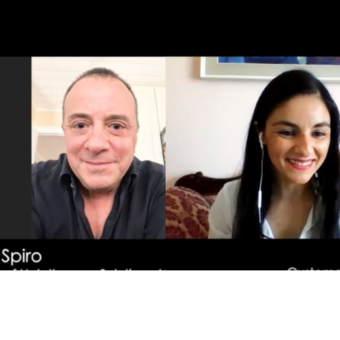
Interview With Giuseppe Littera – How Complementary Currencies Are Disrupting The Banking Sector?
Complementary currencies are not national currencies but have acceptance for use in specific conditions in a nation. Investopedia explains that complementary currencies are set up by private citizens, advocacy groups, or public regulatory bodies to create parallel markets for specific goods and services, or within a specific geographic region, with the goal of regulating the economy or achieving a particular social, environmental, or political purpose.
A successful example was established ten years ago in Sardinia by a group of friends and it has been working very successfully ever since. I met with Giuseppe Littera, co-founder of Sardex to find out how complementary currencies can help a suffering economy and how these can impact the banking sector. Sardex has been featured in many publications such as Financial Times, Forbes, Wall Street Journal, CBS and mentioned by highly reputable economists around the world.
IV: Hi Giuseppe
GL: Hi Ilenia
IV: Thank you for spending the next twenty minutes with me, thank you for having me in this beautiful office which as you say it’s an old farmhouse converted into an office. I can already feel the peace and serenity here. I believe it can let you concentrate and focus more here rather than in a regular office, doesn’t it?
GL: I think we kept the headquarters in the countryside, in Serramanna for work and also because we wanted to contribute to the economy of this little town. So yes, I am pretty proud that we are still around and kicking in.
IV: Yes nice! So you are one of the founders of Sardex right? I have seen this company featured in Many magazines and publications and very important ones, such as WSJ, Financial Times, Forbes, CBS and you’ve been mentioned by highly reputable economists all over the world. This is amazing, well-done guys!
GL: It’s also a bit responsibility I would say but thanks.
IV: No worries. I am here for the main reason to understand how this way of buying and selling things is, in a way, disrupting and impacting the banking sector, but let’s start to understand how it really works.
GL: In a nutshell, Sardex facilitates trading between mainly companies, and now workers and consumers, who have the productive capacity. That means that they have something that the common market, the normal market is not absorbing, so it might be empty hotel rooms, it might be your time as a dentist that’s not booked, it might be your English classes that are half full. Basically, any company apart from weapons dealers and very dangerous toxic pharma industries are not allowed in the network but apart from that basically 99% of companies can participate and when they do participate they are sharing their capacity and abilities with each other. By entering the network they sign up a subscription and agree to a yearly volume that they commit to the network. So the first step is a commitment to the rest of the network that’s made up of companies. Based on this commitment which is as I was saying before, for the hotel might be 10.000 Euros worth of unsold rooms or holiday packages. This concept of ability is the power behind the currency. Actually to be more precise the credit unit because Sardex is a credit unit that is one-to-one packed with the Euro but is not interchangeable for the Euros and can only be spent in the network and can only be created by those who partake in the network. Those who participate in the network create Sardex when they trade, so, for example, the dentist commits to 5000 Euros worth of my services and the platform calculate a credit line based on this productive capacity and the demand that there is in the network for that good or service offered. Let’s say that the dentist gets a credit line of 1000 Euro and the next day he goes out and buys dinner for his fiance and pays in Sardex. Now, at that moment his account goes negative from 0 to let’s say 50 and those 50 that he has just paid have been effectively created by him at the moment of trade. All of this happens without interest. These are roots that stand from City-states and the first forms of writing: the clay tablet that you can see in the archaeological museums. You see the clay tablets from Mesopotamia and well what they are, are records of agreements. And that’s what we chose as the base of our economic model: it’s to get rid of interest. That was also meant to distinguish the nature of Sardex as credit-based units of accounts as opposed to normal money which is debt-based and it generally comes with interest attached.
IV: It sounds like Sardex is revolutionising the way businesses and consumers buy and sell things in Italy, right? Do you think this way means something for the banking sector, how do you think the banks see Sardex? Perhaps as a threat for example. How do you think it’s seen?
GL: Well, first of all, I wouldn’t say they would see us as a threat since we have our own board of shareholders, one banking foundation and also the technology arm of a bank. Plus other investors, some institutional and some from the venture industry. I don’t really think that it is a matter of conflict or even competition because the nature of what we do is very different. We are trying to help companies with working capital needs regardless of financial market conditions and regardless of political conditioning that affects rates. Again, do you know any bank that can work without interests? I don’t know any. What we do works exactly because there is no interest and in that sense, I wouldn’t see us as a threat. I see us as a servicing and another entity providing services to the core customers of banks which are SMEs. We believe that the economy should not just rely on one particular form of money or one particular form of credit and that is debatable and many bankers might disagree or frown but I think it’s quite hard to argue that banking as it exists and it is configured right now is perfectly functional and works as well as a wheel. A wheel is a human invention that it’s rounded and it just rolls, it just works. Now if we think about money and banking.. well I don’t think we figured out the equivalent of the wheel. It’s more like a squared wheel where every once in a while you’ve got a crisis, you’ve got to ask the help of someone bigger, either the central bank or the state. Nothing of what we do depends on these entities. We and the success of Sardex is truly connected to the way businesses and people embrace it. It is voluntary and that’s the most revolutionary part of it: it’s a real economy-based system that has no interest, that’s based on subscription rather than fees extraction. We try to be generative rather than extractive and we try to enable connections from the bottom up, not top-down.
IV: That’s really interesting and what I was saying about the revolutionising bit of the banking sector is because banks if they were to lend money to SMEs as you were saying, they will be charging interest. Not lending money they won’t be gaining any interest so there won’t be any money gaining from their side and that’s why probably the banks see you like a little bit of a threat you know because in this local economy they might be saying: oh I can lend you money. No, I actually have Sardex that can lend me credit and in that way you are kind of making a little bit of noise.
GL: Yes it might be but there is another problem; banks when they rate companies they have to follow certain rating standards which we are free to follow or not. They have to because that’s regulation: Basel 3, Basel 4 etc etc. Sometimes in Sardinia, that’s the case and in many peripheral local economies in the Eurozone, for instance, banks don’t lend. That’s the big problem, that businesses might have demand they go and ask for a loan, well I think the latest data I saw from the ECB we are talking about 1 out of 4 companies that get a “no” and more than 1 out of 4 that get less than what they need. For instance, we collaborate with Banca Etica and Banca Etica together with us has financed a couple of our Sardex participants who needed Euros but they couldn’t get as much Euros as they needed. So there we built something that we call a blended loan where you have a portion in normal money and the remainder around 20/30% in community currency – in Sardex. So you see anything can actually work together, the point is that in our case we are trying to be as generative as possible and we are not focused solely on maximising profit, for us purpose comes before profit and I think also people should come before price.
IV: Absolutely, I cannot agree more with you!
GL: I know, I don’t think banks would agree with it
IV: You are a community based and purpose-based business, which is actually what customers want today, in today’s digital world. There have been so many years where banks have wrecked us as businesses and consumers, with their interests and commissions, shady commissions, hidden fees. Absolutely, I cannot agree more with that. In this digital world, I am actually asking myself what is the meaning of the banks today? You know, there is such a big revolution with the banking sector at the moment, as you probably know, there has been a massive boom of neo banks, digital and complementary currencies, and peer-to-peer lending and crowdfunding over the last decade. So what is the meaning of the banks today, you know, it’s a nice question. They have been failing to provide the basics of the customer service and the services to their customers. Customers are so fed up with the services they get from them right? So it’s unbelievable the revolution that we are seeing here today, something that we wouldn’t have seen 20 years ago for example, because we would trust the banks so much that we wouldn’t have seen it.
GL: Yeah I think that there might be another angle to what you are saying. On one hand probably trust in the financial sector was higher back then, technology wasn’t as developer-friendly and also probably we owe, as a society to not just stop at rethinking the role of banks and the meaning of the word banking but I would go farther and I think we are in need of something bigger as a society and as a developed society in particular, because we are definitely seen as a developed world growth rates that are minimal but even in rich countries if you measure the happiness level you realise that really money doesn’t make people happy, sometimes passed a certain threshold is really irrelevant, so I would probably recall Gramsci and the bit where he was saying that between two old paradigms, a new paradigm is always an interesting but dangerous time because that’s generally when monsters arise. So we’ve got to be probably very careful, we are not trying to become a monster but it’s really that societies are at a crossroad or in the middle of a changing process and when there are these sort of moments there are also power relations that come into play and as much as the financial sector might not be trusted as before the power and the legal arrangements around banking, competition or alternative or anything that’s not fairly standard is very difficult to set up. We are one good exception I would say, we’ve developed our business model to be exempt from regulation, we chose some features that we were describing on purpose, to differentiate ourselves deeply from old models and old ways of understanding the economy. I think we are owed to, as a society to not be trapped and definitely to not be limited between what I may say choice between big finance and big tech, I think we’re owed to have a third pillar and that is a community-based finance because communities are in the end those who prosper or suffer when big banks or big tech do they mistake. Think Lehman Brothers and think Facebook and now Facebook that’s going into crypto, I rather see a world of careful communities that are sufficiently resilient and not just efficient, because banks and banking are being driven by efficiency. But you know when a complex system gets too efficient might also be vulnerable to black swan events or changing environments and by not being resilient because you know, only one way should work. It ends up being very fragile.
IV: For centuries banks only concentrated on making money and profits and not actually concentrating on serving customers right? So I am glad that you guys as Sardex, as a business, as a community concentrate on the community, on trust, on values. This is what customers want today basically and the good thing is that technology today is giving the opportunity for people like you to create opportunities and to create opportunities for communities, for us as well. So there is so much choice right now, there are alternative ways of paying, storing money and borrowing money from other sources that we have the power.
GL: Yeah, there is definitely a possibility for a bigger and bigger shift. I don’t think it will only be dictated by the preferences of us people, as you know banking is the most regulated business. Generally, people complain a lot about banks and their dealings but banks can only operate within certain parameters that are set by lawmakers. It’s a strange position that are banks because they are providing a public service, credit is truly something public but they are generally for-profit enterprises and this is where it gets the conflict between the for-profit vs the original purpose, why they were set up.
IV: The other day, for example, I was reading an article about the banking sector and this article mentioned that by 2025 nearly 2 billion people will have their banking experience on their phone and 80% of them will never walk in bank branch again. So it means that everything now is basically controlled by our phones and by technology so technology is shifting the power so much
GL: Now you are making me think about the danger of relying only or mostly on technology. There is a big, huge push, towards branchless banking that definitely is digital banking. We don’t have a branch but we are not a bank, but what we do care is slowly going and fading away in commercial banking is the relation with our customers and the quality of relations between the network and the community that works with us. That is something that I worry quite often and that is the society going cashless. Even though everything we do is digital, I am very worried about the cashless trend. It’s definitely worrying for two reasons to me mainly: One is, once we go cashless we are relying 100% on of bank mediated credit. Second, a cashless economy is on a human rights level, potentially, very scary. Now, imagine you have not access to cash and by cash, I really mean paper that works offline regardless of electricity. What happens if there is an outage or there is a hacker take over of the system that is not perfect as it has been designed by humans, so it has flaws. I’d rather hope that we as a society do not ditch paper-based financial instrument just because paper is old, look at this shiny phone, because there is a hidden cage behind the phone and there is hidden freedom in being able to transact freely and in a completely private manner. There is a systemic issue and also the personal issue of financial privacy. Now, people argue that there is no such thing as financial privacy today. I might agree but I think it should still be a human right as it is freedom of speech. We do claim freedom of speech as a human right – we don’t have freedom of transaction.
IV: You think more for the society, which is good. You are very based on society values
GL: Yeah I don’t know if this is good or bad, somebody might argue that it’s not good for business
IV: No, it’s just your view
GL: But I believe is actually not immediately achieved but the gain of staying human of building relations, community by community of empowering SMEs, workers and consumers to trade, regardless of the availability of official regulated forms of currency, credit and money, which are all different things but nobody cares, I think it’s important.
IV: I have seen that there are various complementary currencies of this kind in Europe, and I have to be honest, I didn’t know about this until Sardex became such a big thing in Italy and Sardinia. How do you see this concept evolving over the next decade?
GL: I am working very hard and I have been working very hard trying to address technical and social scalability issues community currencies have. I believe we are pretty close to a model we believe could be socially adopted worldwide in any community but is going to be dependent on the availability of the internet, that’s a big limitation that we should strive to overcome
IV: Well, it’s getting better and better. Hopefully! Fingers crossed
GL: I see going forward probably the most reasonable option as I was saying between big finance and big tech and this sort of third way that’s a human and community based still has some elements of banking and some elements of technology but it’s purpose-driven and it’s impact-driven. Then secondly, of course, it is profit-driven. I think purpose and impact have to come first and well, of course, caring for the success of those who participate is vital. Then going forward another thing that I would love to bring about is more and more community accountability, mutually reinforcing mechanisms that community currencies basically stand the test of time. A few community currencies last for more than two years, we are an exception in that, some don’t even start. There are plenty of announcements: “oh we are launching this and that”. We personally never did a launch, we first worked and then after three years we said “we exist”
IV: I agree with that. There are a lot of companies that actually claim “ we are launching this new product” but they haven’t actually tested the viability of the product
GL: Exactly! Being close to the market has helped us, it continues to help us but we have to be out here in terms of thinking because if we keep on the same rule book we won’t go anywhere. It’s beyond a nice mobile app, it is a nice mobile app but it has to have a soul, it has to have a drive that goes behind Dollars in the eyes.
IV: I love this view and I love your values guys seriously. I have a lot of admiration for what you’re saying right now and I would like to end up this very interesting topic, which I don’t want to take too much of your time, but I’d like to end up with a nice analogy that someone mentioned in a Forbes article I was reading the other day. I’d like to read it to you. It is Laura Ortiz Montemayor, is the CEO of an investment firm in Mexico. “The way fintech is designed, it often puts more people in debt. Debt is like poison; Sardex turned that poison into an antidote.”
GL: I mean she said it.
GL: it’s actually bigger than that, not in our terms. It’s the poison part that’s very hard and I feel totally flattered and we should all be, our company and community should feel flattered. That she understood that community-based credit it is an antidote to interest burying, never-ending debt that shackles relations. She was spot-on on that. So thanks a lot to Laura Ortiz and to you for the questions
IV: It was really good. I really liked this analogy that summarises very well what we’ve been talking so far in this interview but summarises very well the actual heart of your company right? I am so glad to be here and thank you so much for spending this time with me, for inviting me and for having me.
GL: It’s been a pleasure. Thanks to you for coming
IV: Thank you, Giuseppe. Thank you so much, anyone, for tuning in. If you have any questions please let us know, we’ll be happy to answer any of your questions. Thank you