
Consumer behaviour change #4: “Home is where I feel safe”

Number four of my consumer behaviour changes after COVID series is called “Home is where I feel safe”. People around the world have been told to self isolate so returned in mass to their epicentre of life and realised that staying at home is not that bad. We took for granted how comfortable it was to stay at home right? Consumers have been injected with the fear of the virus which has led them to prefer to stay at home even in phase two of this global lockdown. During and after quarantine they have been virtually connecting more than ever even when apart so this is leading to think that “Home is where I feel safe”. Going forward we will not see the lockdown extreme but consumers are changing some of their habits for sure. There will be a lot of social distancing for now and beyond, people are afraid and putting their health as their priority. Fear is injected into us, therefore a lot of industries are going to suffer over the next 18-24 months because people will have fear of travelling, eating out and staying in crowded places.
Millions of people around the world have lost their job and businesses but the majority of people transitioned to remote work during the outbreak. The interesting thing is that this relates to businesses as well. Most companies in every industry have replaced long commutes with video communication platforms and remote work tools without feeling any urgency to go back to the old ways. Will this be the end of useless face-to-face meetings and will it be the start of a work-from-home culture? Remote work is expected to become more widespread and finally more accepted by employers. Two weeks ago, Facebookannounced that most of its employees will be working from home through the end of 2020 and Google’s parent company Alphabet planned the same.
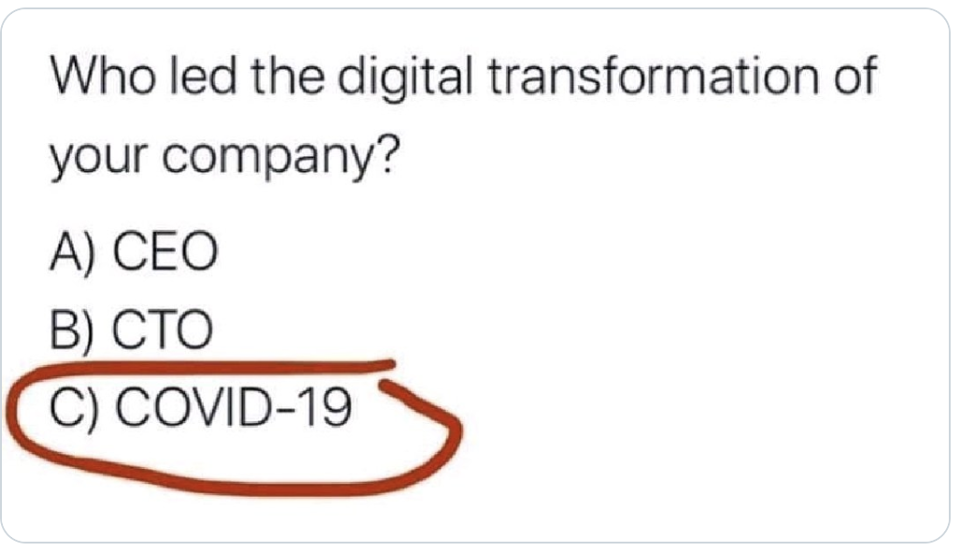
In the first article of this series, I mentioned that COVID was the push that companies needed to finally embrace the technology available out there. My view is that this is the time where companies really require continuity and not only via video conferencing but through a whole digital transformation that creates agile working environments which allows them to respond quickly to the ever-evolving consumer needs. I found this image on the internet and thought it was very intriguing and possibly real for many organisations.
What should businesses do about it?
As consumers are and will be spending more time at home it makes sense that you shift your communication and messaging more around the home, but most importantly that you bring your business to people’s home, where they feel safe. Digital transformation is integrating technology in every area of the business to solve traditional problems, but digital transformation on its own doesn’t mean much if businesses aren’t putting customers at the centre. Most companies see digital transformation as a way of using technology to create operational efficiencies that reduce costs. While that’s an important goal as well, very often the same companies pay the price of losing customers who have gone through a bad customer experience. Digital transformation initiatives must start with the customer experience in mind because competitive advantages as a result of customer experience strategies attract customers who then become advocates which is equal to recurring revenue. In his book The Practice of Management, Peter Drucker said,
“The purpose of a business is to create a customer.”
I would add that the purpose of a business is also to provide an unprecedented value to customers. Now it is the time to reassess digital initiatives and implement those that provide value to customers and that will help you stay close to their needs during and post COVID. The most successful digital transformations begin with the customer experience and are focused on having the customer at the centre. Customer data is used to inform decisions and apply a design thinking approach built on flexible and modern platforms that create superior customer experiences. Digital transformation is not an easy process, it takes time, dedication and consistency but there is a silver lining in any adversity — COVID-19 may be the right push that you need.
More consumer expectation changes in the next article. If you missed my latest customer experience webinar: “Adapting Customer Experience in times of COVID and beyond” you can watch the replay by registering your interest here.