
Duolingo: A Masterclass in Designing Customer-Centric Disruption
How Duolingo reinvented education using gamification, AI, and customer psychology – and what business leaders can learn from it.
I still remember struggling through English textbooks in high school, memorising verb conjugations and vocabulary late into the night. I’d start strong, get distracted, give up. Repeat. Those formal, boring classes drained my energy. Recently, I decided to brush up on my French and tried something new: Duolingo, the most downloaded language-learning app in the world. Instead of dusty books, I found myself tapping on my phone, earning points for translating sentences about owls and apples.
It hooked me immediately.
So what changed? Why did a green owl succeed where schools failed? This made me think about how Duolingo turned language learning upside down, and what we can all learn from it.
Breaking the Education Mold
Founded by Luis von Ahn, Duolingo made learning playful, a radical shift from the rigid, costly systems he saw growing up in Guatemala. Duolingo was born from a radical question: what if quality education could be free for everyone?
“I wanted to give equal access to education to education” – Luis von Ahn
Traditional providers charged high prices and targeted only the most profitable customers. Duolingo flipped that model, offering free access through smartphones. It was simpler, widely available, and initially dismissed by companies like Rosetta Stone, who focused on enterprise clients and hefty software packages. That high-end model excluded anyone who lacked time or money. Duolingo targeted the overlooked: hobbyists, students, or anyone without access to pricey courses or tutors.
Duolingo nailed it by understanding the customers’ needs. Learners didn’t just want knowledge (functional need), they wanted motivation, simplicity, and flexibility (emotional need). Many like me download Duolingo for a clear objective: “Help me learn a language in a way that is easy, fun, and fits my daily routine.
Duolingo also recognised that in the attention economy, you’re not battling rivals in your category; you’re battling everything that steals a user’s focus: Instagram, YouTube, Netflix, etc. So the real question was: how do we make people want to come back each day? The answer wasn’t more grammar, but it was more fun.

The freemium business model helped Duolingo scale fast. By offering a fun, zero-cost way to learn, it attracted over 116 million monthly users and 40 million daily active users in 2024, most of whom never pay. But that’s the genius. Once hooked through daily streaks and gamified lessons, a portion upgrade to the paid version. As a result, at the end of 2024, Duolingo had 9.5 million paid subscribers worldwide and saw revenue soar to $748 million, up 41% from the previous year.
The Psychology of Sticky Learning
What makes Duolingo truly remarkable isn’t just its freemium business model but its understanding of human psychology. The company transformed learning from a chore into a game, leveraging gamification and creating a “sticky” environment. Behavioural scientist BJ Fogg would call them “tiny habits”, built through three clever mechanisms:
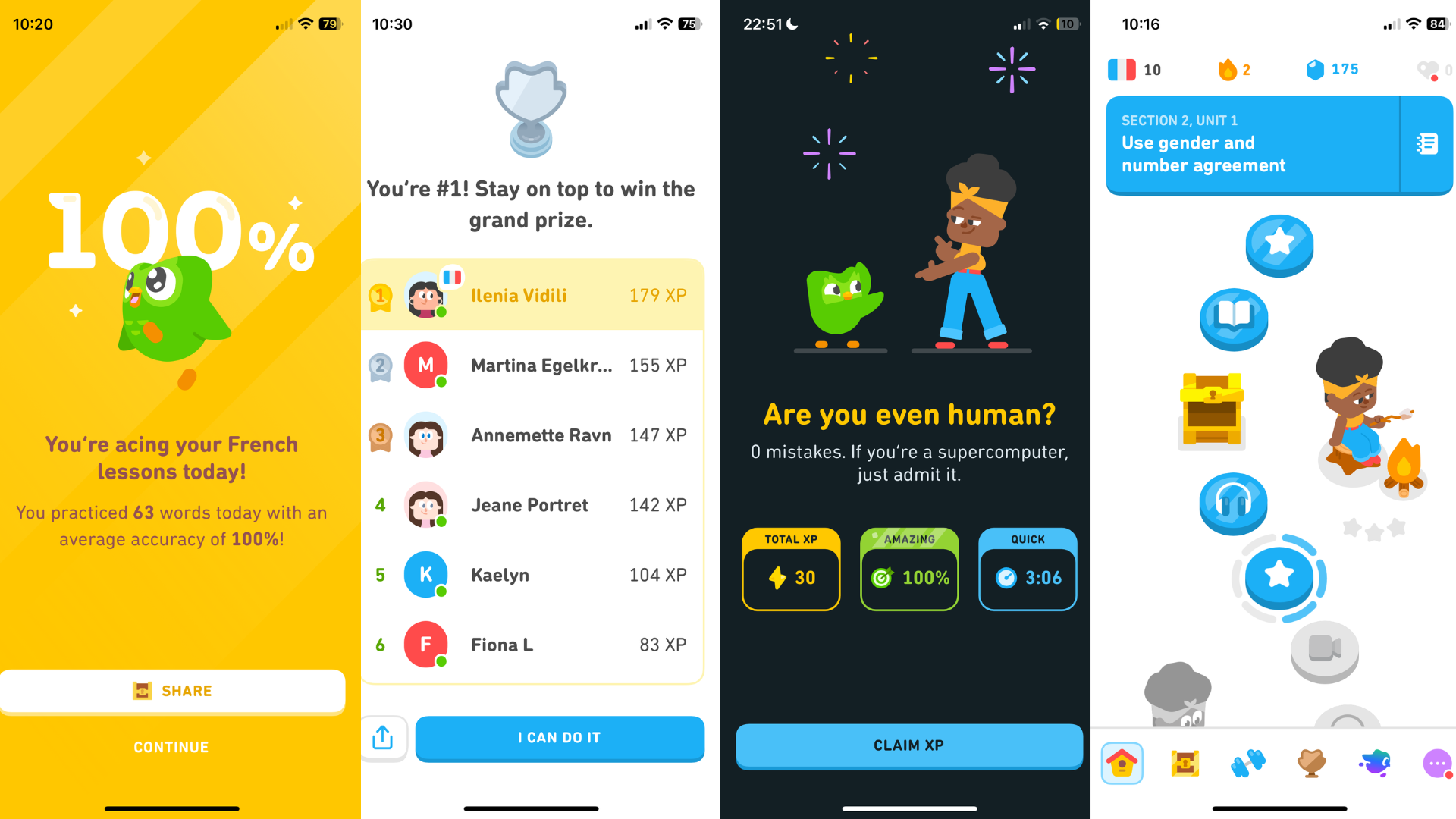
The Commitment Device: Each day, that streak counter creates what economists call a commitment device, a psychological tool that helps us stick to our goals. I’m currently on a 47-day streak, and the thought of breaking it genuinely pains me.
Micro-Learning Architecture: Each lesson feels like a 5-minute mini-game, with points, badges, and cheerful sounds rewarding your progress. This micro-learning approach meets customers where they are: in their phones, their routines, and their busy lives — at war with digital distractions. Suddenly, practicing French feels more like playing a game than studying.
Social Reinforcement: Learning a language isn’t purely about memorising words, there’s a big social and motivational component. Duolingo built a social layer into the experience, a network of forums, clubs, and live events. It recognised that people build habits more easily when they feel part of a community or friendly competition.
Streaks, micro-lessons, and social hooks aren’t just fun, they form a deliberate customer retention strategy.
The AI Revolution Behind the Scenes
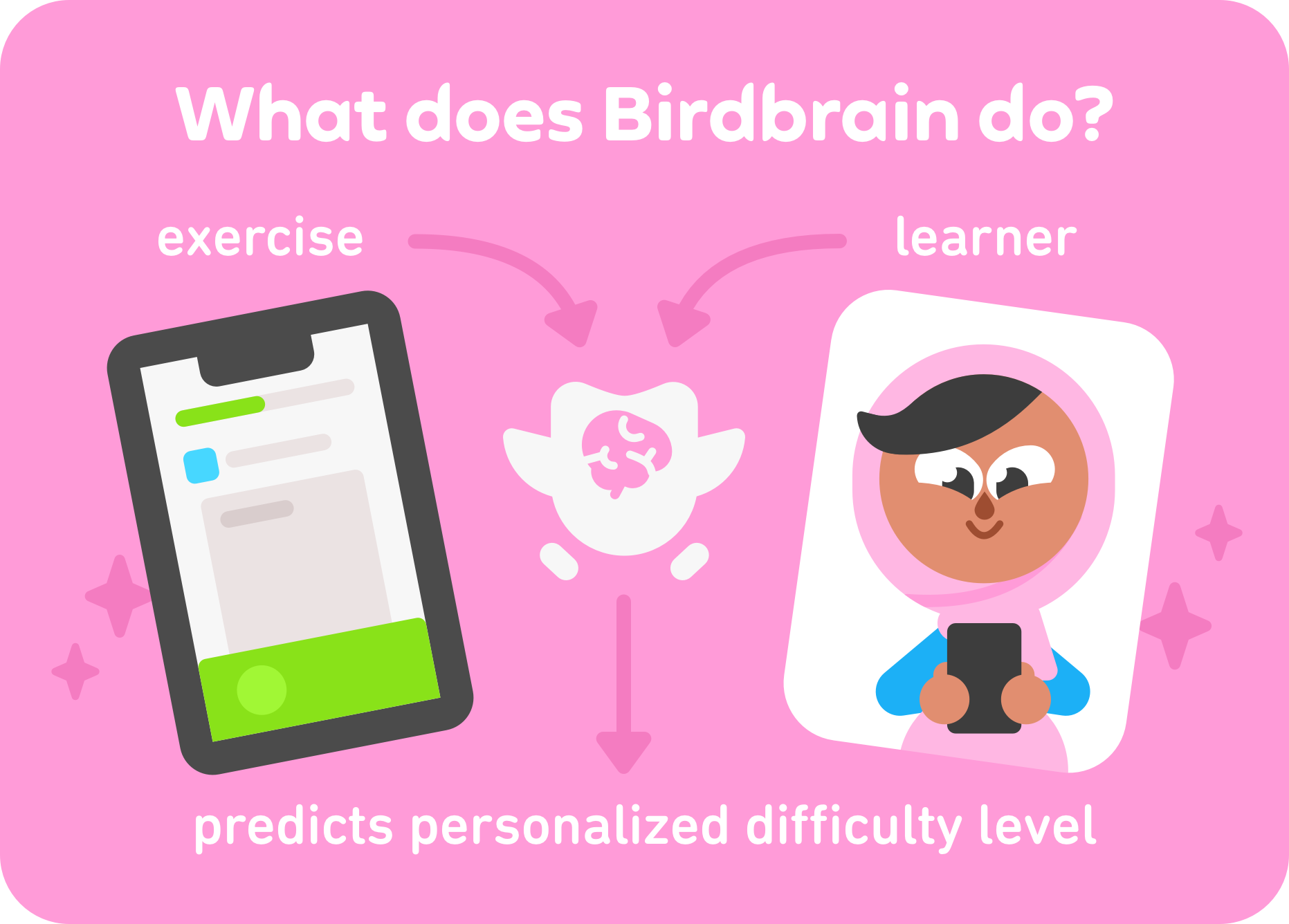
Duolingo leverages its massive user base to improve the product daily. With millions of users completing exercises every day, it has a mountain of data on what works in language learning. Duolingo AI “Birdbrain” is the engine behind my personalised learning experience. It analyses how I answer questions and predicts how likely I am to remember a word or get an exercise right. If I am breezing through a topic, the app will serve me tougher sentences; if I’m struggling, it will adjust and give me extra practice on the basics. Duolingo AI Birdbrain fine-tunes the lessons in real-time for each learner, making the experience feel almost like a personal tutor. This personalisation drives what education researcher Benjamin Bloom identified as the “2 Sigma Problem” – achieving results close to one-on-one tutoring combined with mastery of learning techniques.
The more people use Duolingo, the smarter Birdbrain gets at optimising lessons. It’s a virtuous cycle that traditional education models just can’t match. The true innovation here isn’t just using AI for education but creating an experience that feels human despite being powered by algorithms. Every congratulatory message and review session comes from data science working invisibly in the background.
Thinking Like An App
In the early years, Duolingo opened up an Incubator program that let volunteers contribute to building new language courses. Fans of Irish, Hawaiian, and Navajo joined in free to create lessons, driven by the passion to share their language. This co-creation approach meant Duolingo could offer languages that big companies wouldn’t invest in and do it at a fraction of the cost. While traditional firms hired linguists and built everything in-house, Duolingo built a community-powered ecosystem. That’s smart business: connecting those with knowledge to those who need it through tech. I explored this kind of co-creation strategy in depth in my book Journey to Centricity, where I highlight how the smartest organisations don’t just build for their customers — they build with them.
Beyond Languages
I remember how dreadful learning math was. I was never cut out for numbers. I always wished there had been a better way. Duolingo realised its “fun + effective” formula could apply to more than languages. People began asking: why can’t math or music be just as fun? In response, Duolingo began expanding into other subjects.
The same cheerful characters, bite-sized lessons, and gamified exercises are now teaching multiplication and musical notes. It saw an opportunity to become a one-stop learning platform. My 17-year-old sister struggles with math anxiety, but a gamified math app like Duolingo helps her see numbers as a game, not a threat. A language learner might plateau or finish a course, but now Duolingo can offer them a math or music course next, keeping them in the ecosystem.

By building a massive user base through free language learning, Duolingo created what business strategist Sangeet Paul Choudary calls a “platform gravity field” – where the more value a platform provides, the more naturally users stay, return, and expand their engagement.
What’s interesting is how Duolingo identifies gaps in traditional education to tackle. Take music education as an example. Duolingo noted that over 3.6 million students in the US don’t have access to music classes as private music lessons can cost a lot.
Designing for Humans, Not Just Function
At the heart of Duolingo’s triumph is a simple insight: people stick with products that make them feel good, not just those that work on paper. Traditional solutions in education, and indeed in many industries, focus on the functional need – teaching the materials and delivering a service. But they often neglect the emotional side of the experience. Duolingo showed that meeting those deeper needs is what truly drives engagement. The app makes users feel happy, confident and included. It’s no surprise users often say they find Duolingo “addictive” – it’s fun, it’s encouraging, and it fits into daily life.
If you lead a business today, this should make you pause.
Usage comes from how it feels, not just what it does. Duolingo is designed for humans with busy lives, short attention spans, and a need for joy and connection. This is a wake-up call beyond education.
Whether it’s banking, health, or retail, ask yourself: Are we only meeting the functional needs, or also the emotional needs of customers?
Rethink, Reimagine, and Relearn
My French refresher journey ended up teaching me much more than verb tenses. It taught me that any industry can be reinvented with a bit of creativity and courage. An owl on a phone screen reminded me that innovation is about reimagining experiences to delight people, not just making things more efficient or adding more features. Duolingo is a story of being customer-centric to the core: meeting learners where they are, sparking their motivation, and constantly evolving with their needs.
As I find myself checking the app several times daily to see where I sit on the leaderboard, eagerly completing lessons between meetings, or while waiting for the next flight, it makes me think: disruption happens when companies question fundamental assumptions about how things “should” work. The most dangerous phrase in business remains “we’ve always done it this way”.
Duolingo didn’t just change language learning — it rewrote the rules for earning attention, trust, and loyalty. I think the biggest question we should ask is: are we building products and services that fit into people’s lives or asking people to fit into our business?
_________
P.S. Book me for your next keynote, masterclass, or executive advisory!
➤ Take my LinkedIn Learning courses
➤ Get a copy of my book